Every October our phone starts ringing with the same two questions. When should I get my sprinklers blown out? And a little later in the month: it froze last night, is it too late? Here’s how we think about when to blow out sprinklers in Minnesota, what a freeze actually does to a sprinkler system, and what to do if the cold beat you to it. We see this every fall across North Branch, Forest Lake, Center City and the rest of the North Metro.
The short answer for the North Metro
Plan your blowout for the stretch between the end of the watering season and the first hard freeze. For most yards around here, that’s mid-September through mid-October, which is the window we build our sprinkler winterization and blowout schedule around. The University of Minnesota Extension says that for much of the state, blowouts typically happen in the third or fourth week of October. Both are fair. The difference is how much risk you’re willing to carry.
The weather records back that up. At the University of Minnesota’s St. Paul weather station, the median date of the first fall night at 32°F is October 8, and the median first night at 28°F is October 21, based on 1991 to 2020 normals published by the Minnesota DNR State Climatology Office. Median means half of all years get there sooner. Towns north of the Cities, like North Branch, Wyoming and Rush City, don’t get the extra warmth of the metro, so we wouldn’t count on them freezing any later than St. Paul.
If you’re reading this in mid-October and your system is still full of water, don’t wait for a better week. Get on the schedule now.
Frost vs. freeze: what actually hurts a sprinkler system
A frosty lawn and a frozen pipe are two different things. Frost can form on grass when the air is in the mid 30s on a clear, calm night. A freeze is when the air drops to 32°F or lower. A hard freeze is usually counted at 28°F or colder, and the longer it lasts, the deeper the cold works in.
Most of your system’s pipe is buried, and soil holds heat, so one light frost rarely gets to it. The parts at risk first are the ones above ground or close to the surface:
- The backflow preventer. On most homes this is a brass device near the foundation, and it sits above ground by design. It’s usually the first part to crack. We wrote a separate guide on how to winterize a backflow preventer.
- Exposed piping running up to the backflow device and back down into the ground.
- Valves and heads near the surface, especially in low spots where water settles.
Water expands as it freezes. That’s what splits brass, cracks PVC fittings and blows out valve bodies. The damage usually stays hidden until spring, when the system pressurizes and a zone won’t hold water.
Signs it’s time to shut it down
- Overnight lows in the forecast are dipping into the 20s.
- Your lawn has slowed way down and you’re mowing every other week.
- Leaves are coming down and you’ve switched from watering to raking.
- The controller is still running on cold mornings and you’re seeing ice on the sidewalk or driveway.
If two or more of those sound familiar, it’s time.
Give the lawn one last drink first
A dry lawn going into winter is a stressed lawn. UMN Extension recommends watering before the soil freezes so grass crowns can rehydrate, and suggests that if you have an automatic system, or your lawn is already dry, you run it at least once before it gets shut off. Their article Should you water your lawn before winter? explains why. One deep soak a few days before your blowout appointment is plenty.
Already had a freeze? Here’s what to do
First, don’t panic. One frost doesn’t guarantee damage, but the risk goes up with every cold night. Here’s what to do today:
- Turn the controller off, or set it to off or rain mode, so it doesn’t run on a frozen morning.
- Close the main irrigation shutoff. On most homes it’s a valve on the line where the sprinkler supply branches off inside the basement or mechanical room.
- Look at the backflow preventer. If it’s dripping, spraying or visibly cracked, leave the water off and call us.
- Don’t try to thaw anything with hot water or a heat gun. Let the day warm up on its own.
- Book a blowout for the next stretch of above-freezing days so the lines get cleared before the next cold snap.
If something did crack, it’s usually a repair, not a rebuild. Our irrigation repair crew fixes cracked backflow preventers, split fittings and broken lines every spring. Our irrigation FAQs also cover what to expect if a system went through a whole winter without being blown out.
Why the compressor matters
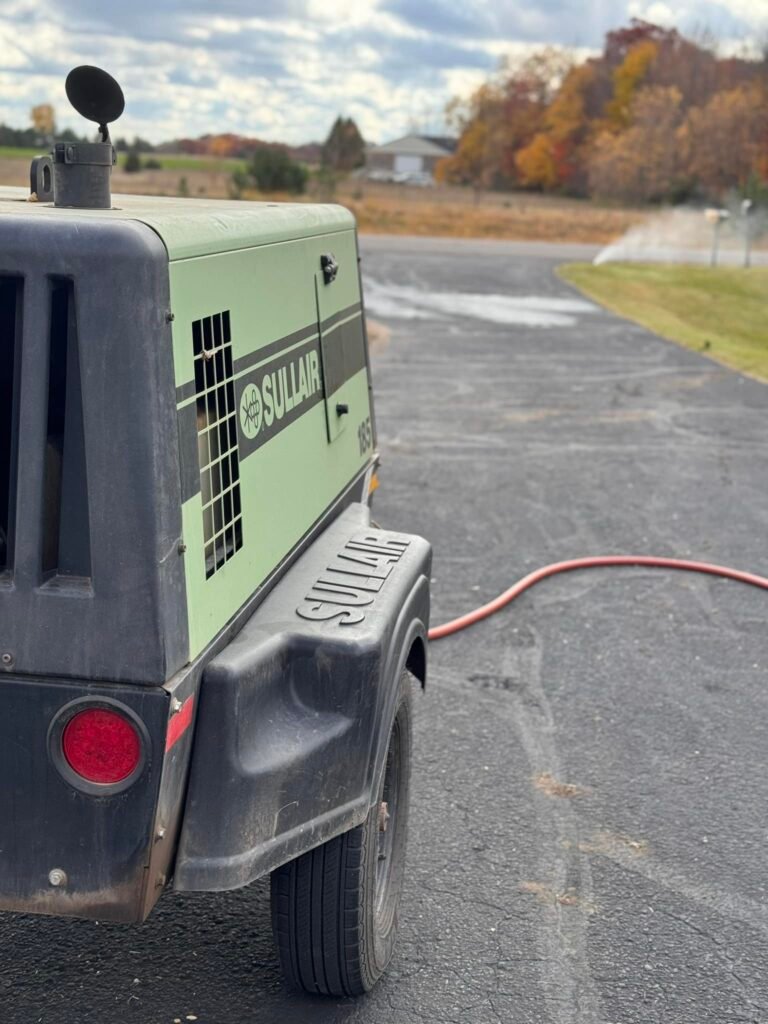
A blowout pushes air through each zone until the water is gone. The key is air volume. We run a commercial compressor in the 50 to 100 CFM range. The consumer compressors most people rent put out about 10 to 20 CFM. A small compressor can clear the heads closest to the valve and still leave water in low spots and lateral lines, which is right where it freezes.
Too much pressure causes its own problems, including damaged heads and fittings. So we run each zone on its own, cycle it more than once, and don’t move on until nothing comes out but air. Then we drain the backflow preventer, close the main shutoff and set the controller to off for the winter. Most residential blowouts take 45 to 90 minutes, depending on how many zones you have.
Where to start: your fall shutdown checklist
- Check the 10-day forecast. If lows in the 20s are coming, book now.
- Give the lawn one deep watering a few days before your appointment.
- Make sure we can get to the main shutoff and the controller.
- Find your zone map if you have one. If you don’t, that’s fine.
- Write down anything that acted up this summer, like a zone that wouldn’t shut off or a soggy spot, so we can check it at your spring startup.
- Request your blowout and pick a date.
Frequently asked questions
Is mid-October too late to blow out sprinklers in Minnesota?
Not usually, but you are close to the edge. At the University of Minnesota’s St. Paul weather station, the median first night at 28°F is October 21, and UMN Extension says many blowouts happen in the third or fourth week of October. If your system is still full of water, book it this week instead of waiting for a nicer one.
Is one frost enough to damage my sprinkler system?
Usually not. Buried pipe is insulated by the soil, and one light frost rarely reaches it. The backflow preventer and any exposed piping are what’s at risk once a real freeze sets in. Turn the controller off, close the irrigation shutoff, and get a blowout on the calendar.
How long does a sprinkler blowout take?
Most residential blowouts take 45 to 90 minutes, depending on how many zones you have. Commercial properties take longer. We need access to the shutoff and controller at the start, and most customers are home for the first 10 minutes and then head out.
Can you blow out a sprinkler system you didn’t install?
Yes. We winterize all irrigation systems, no matter the brand or who installed them. If you have a zone map, great. If not, we find and test every zone ourselves.
Get on the fall schedule
We do blowouts in North Branch, Forest Lake, Center City, Wyoming, Lindstrom, Chisago City, Hugo and across the North Metro. See our full list of service areas, or request your blowout here and we’ll get you on the calendar before the next cold snap.
Need help with your sprinkler system?
We handle installs, repairs, spring startups and fall blowouts across North Branch, Forest Lake, Center City and the North Metro.