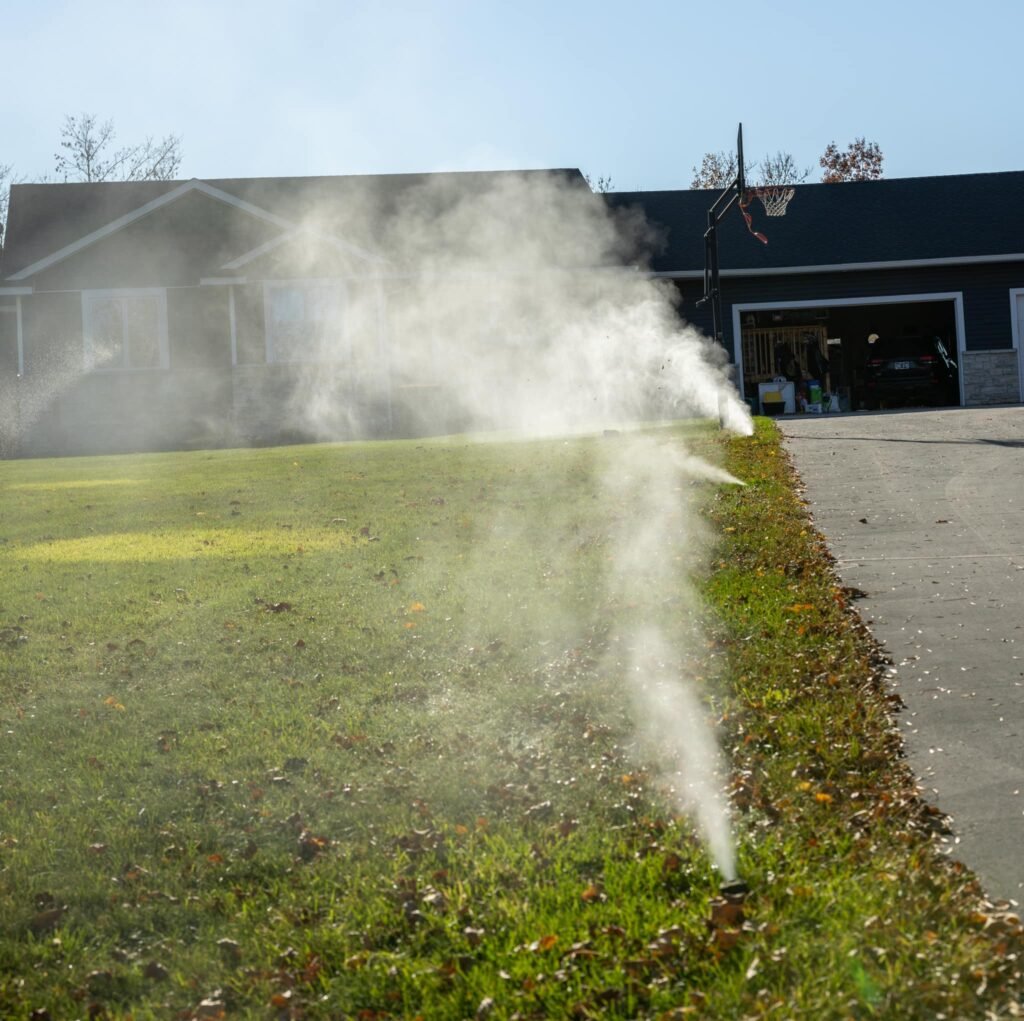
If one part of your sprinkler system is going to crack this winter, it’s probably the backflow preventer. It’s the brass device, usually near your foundation, that keeps irrigation water from flowing back into your home’s drinking water. It sits above ground on purpose, which also makes it the first thing exposed to a Minnesota cold snap. Here’s how to winterize a backflow preventer the right way, the mistakes we fix every spring, and what Minnesota requires for annual testing.
What a backflow preventer does
The water in your sprinkler lines has been sitting in the ground with fertilizer, lawn treatments and whatever else is in the soil. If the water pressure in the street drops, like during a main break, that water can get pulled backward into your home’s plumbing. A backflow preventer is a set of check valves that stops it. Minnesota code requires backflow protection on lawn irrigation, and every residential sprinkler system we install includes it.
Which type do you have?
- Pressure vacuum breaker (PVB). The most common type on Minnesota homes. It’s mounted outside, at least 12 inches above the highest sprinkler head it feeds, with two ball valve handles and two small test cocks.
- Reduced pressure zone assembly (RPZ). Can be installed indoors, often in a basement. It’s used where a higher level of protection is needed, such as systems with a pump or chemical injection, and you’ll see it on a lot of commercial sites.
- Double check assembly. Two check valves in one body, with ball valves and test cocks like a PVB.
All three hold water that can freeze. Even a device inside a heated basement sits on a line that runs outside, and that line still has to be drained and blown out. The exact steps for your model are in its manufacturer instructions. The steps below follow the FEBCO winterization sheet for its 765 pressure vacuum breaker, which is the kind of device most homeowners have.
How a PVB gets winterized, step by step
- Shut off the irrigation supply. Close the main shutoff valve that feeds the sprinkler system. It stays closed all winter.
- Drain the supply line. If your system has a drain valve on the supply side, open it. If it’s indoors, have a bucket ready.
- Open the test cocks. Use a flat screwdriver to turn each small test cock open so trapped water and pressure can escape.
- Close the outlet ball valve before the blowout. Air should go into the sprinkler lines downstream, not through the backflow device. FEBCO’s instructions call for the outlet shutoff to be closed while the downstream system is blown out.
- Blow out the zones. Each zone gets cleared with compressed air until only air comes out. This is the main part of a sprinkler blowout.
- Set everything to 45 degrees. Once the blowout is done, both ball valves and the test cocks get left half open, half closed for the winter.
You can read the full manufacturer sheet here: FEBCO 765 winterization instructions (PDF).
The 45-degree rule for ball valves
This is the step people miss most. A ball valve has a hollow ball inside it. If the handle is left fully open or fully closed, water stays trapped between the ball and the valve body. When that water freezes, it can crack the valve. Leaving the handle at about 45 degrees lets that pocket drain. It looks wrong, but it’s what the manufacturer calls for. If you walk outside this winter and see your backflow handles sitting sideways, that’s a good sign.
Mistakes we see every spring
- Pushing compressed air through the backflow device. The air belongs in the zones downstream. Forcing it through the device can damage the parts inside.
- Leaving ball valves fully open or fully closed. Either way, water stays trapped inside the valve.
- Only opening the test cocks. FEBCO notes the assembly can’t be fully drained through the test cocks alone.
- Skipping the backflow during a DIY blowout. The zones get cleared, and the most exposed part of the system is left full of water.
- Leaving the main shutoff open, or having one that seeps. Water slowly refills the system after the blowout and freezes anyway.
Our irrigation FAQs go into more detail on why rented compressors and quick DIY blowouts so often leave water behind.
Turning it back on in spring
Before the water goes back on, close the test cocks and close the ball valves. FEBCO’s instructions say the ball valves have to be closed before the system is repressurized, and that they should always be opened and closed slowly. Then the supply gets opened slowly too. Pressurizing too fast can cause water hammer, which cracks pipes and blows out fittings. That slow, careful start is a big part of what we do at every spring startup, along with checking the backflow for winter damage.
Annual backflow testing in Minnesota
Under the Minnesota Plumbing Code, testable backflow devices have to be tested when they’re installed and at least once a year after that. According to the Minnesota Department of Labor and Industry backflow fact sheet, that includes pressure vacuum breakers, double check assemblies and RPZs. For devices other than RPZs, the testing rule applies to ones installed on or after January 23, 2016. RPZs must be tested every year no matter when they were installed.
The test has to be done by a certified backflow tester. The state certifies testers through its backflow prevention certification program. The owner of the device is responsible for getting it tested, and many cities have their own reporting forms and deadlines, so check with your city if you’re not sure what it expects.
A fall winterization is not the same thing as an annual test. If your device is due for a test, or it’s leaking or cracked, our irrigation repair service covers backflow testing, repair and replacement.
Where to start: backflow winterization checklist
- Find your backflow preventer and figure out which type it is.
- Look it over for drips, cracks or heavy corrosion before freezing weather arrives.
- Make sure the main irrigation shutoff closes all the way.
- Book a blowout that includes draining the backflow. Ours always does.
- After the service, check that the ball valve handles are at 45 degrees and the test cocks are open.
- If your device was installed in 2016 or later, put its annual test on your calendar.
Not sure if you’re cutting it close this year? Our guide on when to blow out sprinklers in Minnesota covers fall freeze timing and what to do if it already froze.
Frequently asked questions
Do I need to winterize my backflow preventer if I’m getting a blowout?
Yes, and on our blowouts it’s already part of the job. We close the main irrigation shutoff, drain the backflow preventer, clear every zone with air, and set the controller to off. If you do your own blowout, don’t skip the backflow, because it’s usually the first part to crack.
Why are my backflow valve handles turned sideways for the winter?
That’s on purpose. Ball valves trap water inside if they’re left fully open or fully closed. Setting the handles about halfway, at roughly 45 degrees, lets that water drain so it can’t freeze and crack the valve. Close them before the water goes back on in spring.
Does my backflow preventer need to be tested every year in Minnesota?
Testable devices like pressure vacuum breakers, double check assemblies and RPZs must be tested at installation and at least once a year after that. For devices other than RPZs, the rule applies to ones installed on or after January 23, 2016. RPZs must be tested every year no matter when they went in. Your city may have its own reporting form or deadline.
My backflow preventer cracked over the winter. What now?
Keep the irrigation water shut off and call us. Depending on the damage, the device gets repaired or replaced. We diagnose it first and give you a price before we do any work, and we can take care of it during your spring startup visit.
Let us take care of it this fall
Every blowout we do includes draining the backflow preventer and leaving the valves set right for winter. We serve North Branch, Center City, Forest Lake and the rest of the North Metro. Request your blowout and we’ll get you on the schedule.
Need help with your sprinkler system?
We handle installs, repairs, spring startups and fall blowouts across North Branch, Forest Lake, Center City and the North Metro.